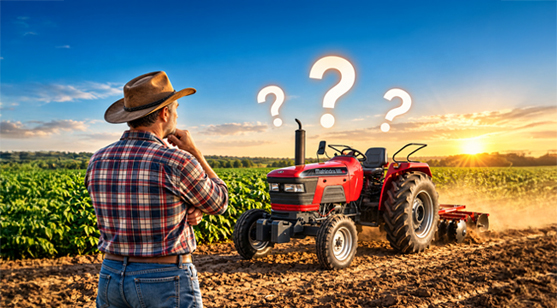
A tractor purchase is not a decision that should be rushed. It is one of the most significant investments a farming household will make, and the consequences of getting it wrong are felt across multiple seasons. The farmers who consistently make smart equipment choices are not necessarily those with the most experience or the largest budgets. They are the ones who ask the right questions before signing anything.
Here is a practical set of questions every farmer should work through before committing to a tractor purchase.
What Will This Tractor Primarily Be Used For?
This is the most important question in any tractor buying checklist and the one that shapes every answer that follows. A tractor used mainly for primary tillage across open fields has different requirements from one used for orchard spraying, paddy transplanting, or material handling around a farm yard.
Clarity on the primary use case determines the right horsepower range, the most suitable transmission type, the hydraulic capacity needed, and the implement compatibility required. Without answering this question first, every other specification becomes difficult to evaluate meaningfully.
Does the Horsepower Match My Actual Needs?
Both underpowered and overpowered agricultural tractors carry costs that farmers often underestimate at the time of purchase. Too little power means the machine is consistently working at its limit, which accelerates wear and reduces performance. Too much power means unnecessary fuel consumption, higher purchase price, and a machine that is harder to manoeuvre in tighter conditions.
Work out the power requirement for the heaviest task the tractor will regularly perform, and use that as the basis for your horsepower selection. This is the most reliable way to identify the best tractor for agriculture on your specific farm.
Are My Implements Compatible?
Before looking at any tractor seriously, compile a complete list of the implements you currently own and those you plan to acquire. Check the PTO speed requirements, the hydraulic flow demands, the linkage category, and the drawbar rating for each implement against the tractor’s specifications.
A mismatch between tractor and implement is one of the most common and avoidable sources of post-purchase frustration. Confirming compatibility before purchase is a straightforward step in any how to choose a tractor evaluation that saves considerable expense and inconvenience after the fact.
What Is the Total Cost of Ownership?
The purchase price is the most visible cost of a tractor, but it is far from the only one. Fuel consumption, scheduled service costs, spare parts pricing, tyre replacement, and the cost of any downtime caused by mechanical failures all contribute to the total cost of running the machine across its working life.
Among the tractor solutions for farmers that genuinely deliver value, the ones that stand out are those with lower total cost of ownership over five to ten years, not simply those with the most attractive sticker price.
How Strong Is the Dealer and Service Network?
A tractor that cannot be serviced quickly when it needs attention is a liability during peak farming season. Before purchasing, visit the dealership and ask directly about service response times, spare parts availability for the specific model you are considering, and the qualifications of the service team.
For farmers in rural or remote areas, the proximity of a competent service centre can be as important a factor in the purchase decision as any specification on the brochure. The best agricultural tractors are those backed by a service network that treats reliability as a shared responsibility between manufacturer, dealer, and farmer.
Can I Operate This Tractor Comfortably for Long Hours?
Operator comfort is a genuine performance variable that many buyers overlook in the excitement of evaluating specifications. A tractor that is physically uncomfortable to operate, poorly laid out, or excessively noisy takes a real toll on operator productivity and accuracy across a full working day.
Spend time in the seat during a demonstration. Check the control layout, the quality of the suspension system, visibility from the operator position, and how intuitive the key functions feel during operation. This is a non-negotiable step in a thorough tractor buying checklist and one that is easy to skip but rarely forgotten once the machine is in daily use.
What Does My Farm Need in Three to Five Years?
Farming operations evolve. Fields expand, crop mixes change, new implements become available, and production targets shift. A tractor purchased purely for today’s needs may be undersized or under-specified for where the farm is heading.
Ask yourself what your operation is likely to look like in three to five years and factor that trajectory into your selection. Choosing agricultural tractors that have room to grow with your operation is a more strategic approach than selecting a machine that fits precisely today but restricts your options tomorrow.
The Right Questions Lead to the Right Tractor
Every farmer’s situation is different, which is why understanding how to choose a tractor starts not with looking at machines but with looking at the farm. The right tractor is the one that answers your specific questions most completely, not the one with the most impressive headline figures.
Take the time to ask the questions, work through the checklist, and make the decision with the full picture in front of you. The tractor you choose will be working for you every season for years to come. It deserves that level of consideration.
